Fairyland: Merge & Magic
- 4.6
- Rating
- 1.00M
- Installs
- Free
- Price

 Analysis by App-foxy
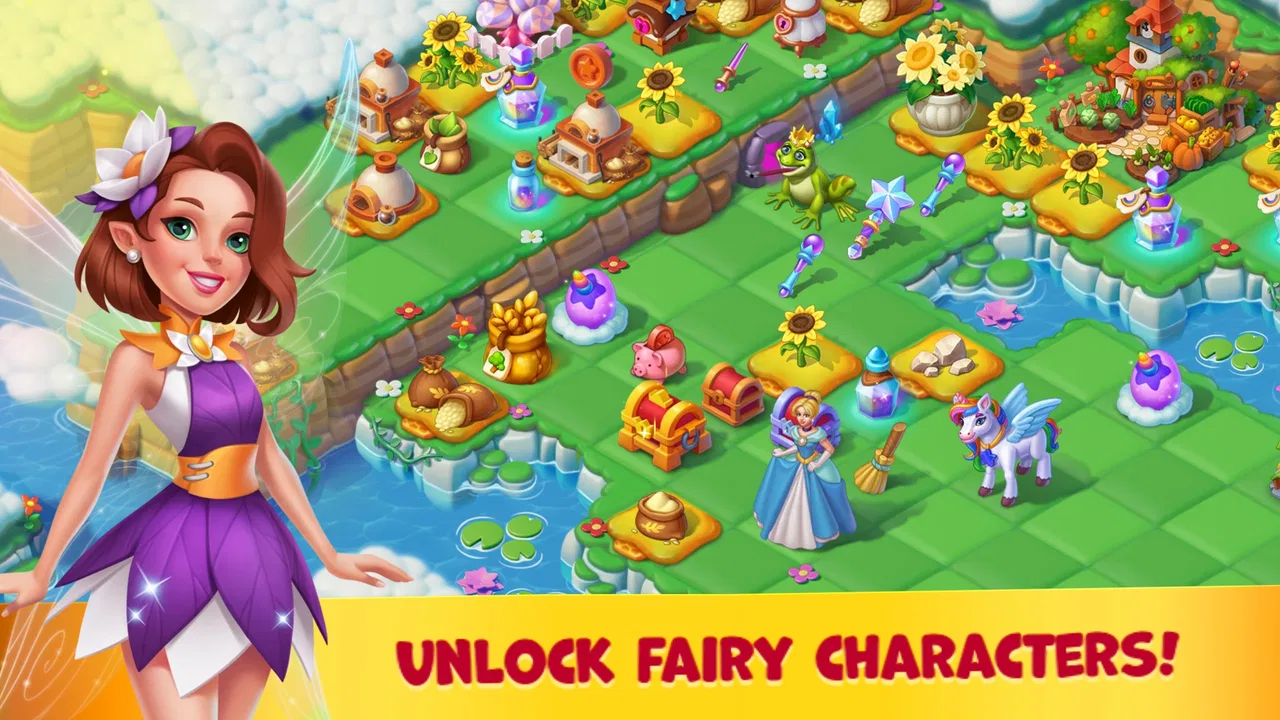
I went into Fairyland: Merge & Magic expecting a gentle island game built around combining objects, and that is exactly the kind of experience it offers. It is a free simulation game from Slimmerbits LLC, with a bright fairyland setting and a simple central idea: bring matching items together to create something more useful, then use the results to keep the island moving forward. The presentation is easy to understand, but the decisions become more interesting once the board starts filling up.
My first impression was that this is less about fast reactions and more about managing space, timing, and attention. You can play in short bursts, yet the game also rewards players who pause before making every merge. That balance makes it approachable for casual players, while the growing clutter can become frustrating if you treat every available object as something that should be combined immediately.
Where the island experience can become confusing
The main place I found myself getting stuck was not the basic merge action. The opening idea is clear enough. The friction comes later, when several objects compete for the same limited room and I had to decide which chain deserved attention first. A merge may solve one small problem while creating another by leaving a new item in an awkward position.
You May Also Like

 Blood Strike: 2.5 Anniversary
Blood Strike’s Loadouts Turn Every Drop Into a Tactical Gamble
A close look at Blood Strike’s custom loadouts: how fast access to signature weapons reshapes its battle royale rhythm, rewards preparation, and narrows the gap between fights.

 Pandora - Music & Podcasts
Pandora’s Music Is Easy to Start, but Harder to Recover
Pandora’s strength is its low-effort path from a seed to a station. Its weak spot is how much confidence it asks you to place in connection, setup, and quiet recovery.

 8 Ball Pool
 Is Built on Rivalries, Rematches, and Routine
A close look at the rivalries, rematches, shared routines, and unanswered safety questions that turn a quick pool match into a persistent mobile community.

 Samsung Music
’s Quiet Strength Is Playing What You Already Own
Its reach comes less from spectacle than from dependable access to a personal library. That simplicity is both the app’s strongest retention engine and its ceiling.

 AccuWeather: Weather Radar
AccuWeather Review: A Quick, Clear Forecast for Everyday Decisions
For everyday plans, the best forecast is the one you can understand quickly. AccuWeather makes rain timing, radar, and local conditions easy to act on, with a few trade-offs.

 Hill Climb Racing
Why Hill Climb Racing Still Turns Crashes Into One More Run
A tiny car, a bumpy hill and one more upgrade: Hill Climb Racing keeps resurfacing because its simple chaos makes every near-miss feel personal.
More From Our News Desk



This is where the game differs from a purely relaxing matching toy. The board is also a storage area, and every unused object has a cost in terms of space. I learned to avoid combining items simply because a match was available. Sometimes it was more useful to keep two objects apart until I could see how the surrounding spaces would be used.
New players may also wonder why progress feels slower after the first pleasant stretch. That is a normal shift in the rhythm rather than a sign that the game has stopped working. Early merges usually make the island feel open and active. Later, each move matters more because the board has more competing goals and fewer convenient spaces.
My most useful early habit was to protect open spaces. I kept at least one clear area instead of filling every gap with low-level objects. That gave me room to react when a task or reward placed something unexpected on the island. It also reduced the temptation to move objects repeatedly just to make the board look tidy.
Why the merge loop works better than it first appears
The satisfying part is the visible transformation. Matching objects makes the island feel as though it is developing rather than merely scoring points. Even when the next step is modest, the chain of small improvements gives routine play a sense of direction. I found that especially useful during short sessions when I did not want a complicated game demanding constant concentration.
At the same time, the loop is not ideal for everybody. If you prefer direct control, rapid challenges, or a clearly defined level that ends after a few minutes, this may feel too open-ended. The game asks you to create your own priorities. That freedom suits me when I want something calm, but it can feel vague when I am looking for a strong objective.
The fairyland theme also affects the mood. It keeps the screen friendly and colorful without making the game feel like a serious management simulator. I would recommend it to someone who enjoys decorative progression and light planning more than competition. I would not choose it for a player who wants deep simulation rules, demanding strategy, or a story that carries every session.
Setup checks before blaming the game
Because this is a mobile game, the first practical step is simple: install it through the normal Android or iOS store route and allow the installation to finish before opening it repeatedly. If the first launch appears slow, tapping the icon several times is unlikely to help. I prefer waiting, closing other demanding apps, and trying one clean launch instead of creating several interrupted starts.
The game is free to download and is marked for Everyone, which makes it easy to try as a family-friendly casual title. It does contain optional in-app purchases, with individual items ranging from under a dollar to amounts close to one hundred dollars. That range is worth noticing before handing the device to a child. I would turn on the device’s purchase safeguards in advance, rather than relying on remembering them after a tempting offer appears.
The current version is 1.503.4, so I would check the store page for an available update if the game behaves strangely after installation. Updating is especially sensible when the problem involves a screen that will not load, progress that appears delayed, or an interaction that suddenly stops responding. I would not assume every issue is a game fault until the installed version has been checked.
A stable connection can also matter during startup or when the game needs to retrieve content. I avoid testing it while moving between weak networks. My preferred setup is to open the game on a reliable connection, leave it alone for a moment, and only then begin making moves. If the device is low on storage or running many background apps, freeing some room and closing unnecessary processes is a reasonable general check.
These steps do not change the game itself, but they remove several avoidable sources of confusion. They are also useful when helping another player remotely: ask whether the app is updated, whether the device has enough free space, whether the connection is stable, and whether the problem happens every time or only during one particular action.
A safer workflow for recovering a crowded board
When my island became messy, I stopped trying to fix everything at once. I first looked for the smallest group of matching objects that could create immediate space. After that, I moved the new result to a deliberate location rather than leaving it wherever the merge happened. This two-step habit made the board easier to read and prevented a successful merge from becoming a new obstruction.
I also separated “progress moves” from “tidying moves.” A progress move creates a higher object or advances the current goal. A tidying move only rearranges the board. Mixing them together can make it hard to understand why the island feels stuck. I try to make one meaningful merge, inspect the available room, and only then reorganize.
Another useful approach is to work on one visible chain at a time. Jumping between several partial groups feels productive, but it often leaves every area half-finished. Concentrating on one chain reduces unnecessary movement and makes it easier to notice which objects are genuinely blocking the next step.
If a merge seems not to register, I do not immediately repeat it. I first check whether the objects are truly the same kind and whether the board has recognized the placement. Then I wait briefly and try a careful drag again. Rapid repeated gestures can make a touch-screen interaction look broken when the real issue is simply that the objects were not positioned as intended.
For a board that feels completely jammed, I would close the game normally and reopen it before taking more drastic action. I would avoid clearing app data or uninstalling during the first troubleshooting attempt, because those steps can affect local progress depending on how a particular device handles saved information. A restart is the safer general recovery step; destructive resets should be a last resort.
There is also a mental recovery workflow that helped me. Instead of asking, “What can I merge right now?” I ask, “Which object is occupying the most useful space?” That question often reveals that the problem is not a missing merge but poor placement. Moving one less-important item away from the center can create enough room to continue without wasting a valuable combination.
When the app is not the cause of the problem
Some apparent failures are really interruptions around the game. A device in low-power mode, a crowded memory state, an unstable connection, or a touch screen that is not registering drags consistently can all make a simple merge feel unreliable. I test the screen in another app and close background programs before deciding that the island itself is malfunctioning.
If the game freezes only after a long session, I treat heat and device load as possible contributors. A short break, a cooler device, and a fresh launch are sensible first steps. If it works normally afterward, the issue may be the phone or tablet struggling with the session rather than a permanent problem in the game.
Notifications and accidental taps are another everyday source of trouble. I prefer playing with the device held steadily and with enough screen space around the objects I am dragging. This matters more when the board is crowded, because a small misplacement can send an item somewhere I did not intend and make the resulting layout look like a gameplay mistake.
Purchases deserve separate caution. If an offer does not complete, I would check the store account and connection rather than repeatedly pressing the purchase control. If a purchase appears to have gone through but the result is not visible, I would first restart the game and review the store transaction before trying again. Repeating a transaction in frustration is a poor troubleshooting habit in any free-to-play game.
The large audience gives some useful context: Fairyland has passed one million installs, carries a 4.6 average from around forty-seven thousand ratings, and has close to one thousand written reviews. Those figures suggest that many people find the basic experience appealing, but they do not guarantee that every device or play style will suit it. I use them as a sign that the game is established, not as a substitute for checking whether its slow, space-focused rhythm matches my own preferences.
Who will enjoy it, and who should choose something else
I think this is a good fit for players who like gentle progression, visual collecting, and light planning. It works well when I have a few minutes between tasks because I can make a small amount of progress without learning a complicated control system. It is also suitable for someone who enjoys improving a shared-looking fantasy space rather than chasing a leaderboard or defeating an opponent.
A realistic everyday use case is a short evening break. I open the game, identify one useful merge, clear a little room, and stop before the board becomes stressful. That approach keeps the session relaxing. If I continue until every space is occupied, the same game can feel more like housekeeping than entertainment.
I would be more cautious about recommending it to children without supervision because the game is free but includes optional purchases. The Everyone rating describes its broad content suitability, not a guarantee that a child will make sensible spending decisions. Device-level purchase controls are important here, particularly because the listed price range reaches from $0.99 to $99.99 per item.
Players who prefer match-three levels, fixed puzzles, or city-building with clearly explained production systems may find a better fit elsewhere. A traditional match-three game gives more immediate goals and cleaner resets. A deeper management simulator usually offers more control over resources and long-term planning. Fairyland sits between those styles: it gives me a relaxing merge board with a decorative sense of development, but it does not replace a serious strategy game.
The developer, Slimmerbits LLC, has shaped the experience around accessibility rather than demanding mastery. That is a strength when I want low-pressure play, but it also means the game may not provide enough complexity for someone who wants every decision to have a major strategic consequence. The right expectation is important: this is a casual simulation experience, not a technical island-management model.
My practical verdict after using the island
Fairyland: Merge & Magic works best when I treat it as a calm, space-management game instead of a race to combine everything immediately. Its strongest quality is the way small merges gradually make the fairy island feel more complete. The controls are approachable, the theme is welcoming, and the free entry makes it easy to test without committing money at the start.
Its main weakness is the same system that creates its appeal. A crowded board can turn relaxation into mild frustration, especially when I make impulsive merges or fail to preserve open space. Optional purchases also mean families should configure purchase protections before play. Those are not reasons to reject the game, but they are practical considerations that the cheerful presentation can make easy to overlook.
I would install it for a friend who wants a low-pressure mobile game with a little planning and a fantasy setting. I would point that friend toward the open-space habit, careful placement, and simple restart checks if the board or loading process seems stuck. I would skip it for someone seeking fast competition, deep simulation, or tightly structured levels. For the right player, though, its gentle merge rhythm makes it an easy game to return to without demanding all of my attention.
FAQs for Fairyland: Merge & Magic
01What is Fairyland: Merge & Magic about?
Fairyland: Merge & Magic is a casual puzzle and adventure game built around merging objects to create upgraded items. As you progress, you explore a magical world, complete quests, unlock new areas, and meet fantasy characters. The gameplay is easy to understand, but later stages require more planning because space, energy, and available resources can become limited.
02How does the merging gameplay work?
The main mechanic is to combine three or more matching objects to produce a more advanced version. You may merge plants, resources, magical items, and other objects needed for quests and island development. Successful combinations help clear the map and unlock progress, although merging too quickly can use valuable space or remove items that might be useful for a future objective.
03Can Fairyland: Merge & Magic be played offline?
Some basic gameplay may remain available without a constant connection, but the complete experience generally benefits from being online. Internet access can be required for advertisements, cloud synchronization, special events, updates, and certain rewards. If you plan to play while traveling, it is best to test the game offline first, since availability may vary by device and version.
04Is Fairyland: Merge & Magic free to download and play?
The game is generally free to download, but it may include optional in-app purchases. These purchases can provide extra energy, boosters, premium currency, or faster progress. You can play without spending money, although waiting periods and limited resources may make progression slower. Before downloading, parents should also review device purchase settings if children use the phone or tablet.
05Is Fairyland: Merge & Magic suitable for children?
Fairyland: Merge & Magic uses colorful fantasy visuals and straightforward puzzle mechanics, making it approachable for many younger players. However, the game may contain advertisements, time-based rewards, and optional purchases, so adult supervision is recommended. The appropriate age rating can differ between Android and iOS, and parents should check the store listing and privacy information before installation.
Pros
- Relaxing merge gameplay that is easy to learn and enjoy.
- Hundreds of items and characters provide plenty of discovery.
- Story quests give progress beyond simply merging objects.
- Bright fantasy visuals make the islands appealing to explore.
- Playable in short sessions
- making it suitable for casual gaming.
Cons
- Energy limits can interrupt play when you want longer sessions.
- Some upgrades and progress may require considerable waiting.
- The number of items can make the island feel cluttered over time.
- Optional purchases may be tempting for faster progress.
- Events and rewards can encourage frequent daily check-ins.

Fairyland: Merge & Magic
Gallery